 Cheung Chau (長洲) looks tiny on a map yet boasts plenty to see and do in a day.
Cheung Chau (長洲) looks tiny on a map yet boasts plenty to see and do in a day.
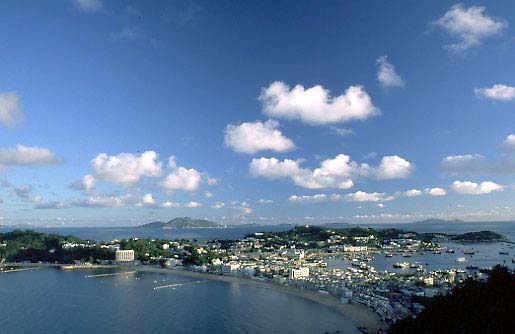
Cheung Chau (長洲) looks tiny on a map of Hong Kong, yet – like the interior of Doctor Who’s Tardis there’s far more to it than may first appear. With coastal trails, beaches, small rural valleys, and a village dotted with temples but with only one (police) car, Cheung Chau boasts plenty to see and do in a day; and plenty to eat once you’ve seen and done.
Though its name means Long Island, Cheung Chau is better described as roughly dumbell-shaped, formed from a north-south aligned spit that connects two big chunks of granite.
With a natural harbour to the west of the spit (now protected by breakwaters), Cheung Chau has become home to one of Hong Kong’s main fishing communities, lately boosted by commuters who’ve made it home.
Arriving at Cheung Chau by ferry
Housing is mainly packed on the spit, and clustered along nearby hillsides – so most Cheung Chau folk are just a few minutes’ walk from the main ferry pier, which links the island to the outside world (Central is just 35 minutes away by fast ferry, around 50 minutes on a larger, slower ferry). Further away, the hills and coasts are relatively wild, and scenic.
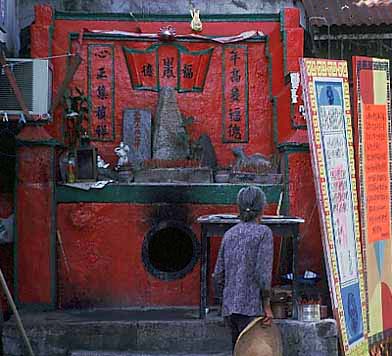
Arriving by ferry, you’ll pass through the typhoon shelter, with the many fishing boats, then leave the pier to find yourself on the main waterfront road, the Praya. On your left, around a couple of hundred metres away, is the Pak Tei Temple, dedicated to Cheung Chau’s “patron saint”, Pak Tei – the Northern King. Visiting this, you can also wander some of the island’s narrow streets, perhaps checking out small stores, and a shrine to an Earth God who looks after his district.
Walk straight ahead from the ferry pier, and just on the right is a road that will quickly take you across the spit, to the main, Tung Wan Beach. This is a fine beach for swimming in summer – it’s hardly pristine, but the water is usually cleaner than at many Hong Kong beaches.
Turn right at Tung Wan, and there’s the Windsurfing Centre on a tiny headland: there’s a small band of windsurfers who are regulars here (the owner’s niece even won Hong Kong’s only gold Olympic medal, for windsuring), and you can hire windurfers as well as sea kayaks.
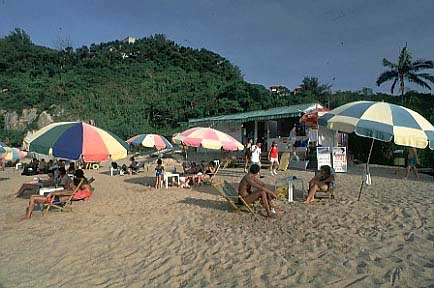 On past the centre is another, smaller but often quieter beach, Kwun Yam, with a shack-style beach bar just above the tideline: a fine place to chill out on a hot afternoon.
The Mini Great Wall(!) – southeast Cheung Chau
From Kwun Yam Wan, you can see steps climbing the headland to the south. These lead towards the path known as … drum roll please … the Mini Great Wall. (Which isn’t a wall at all, but does wind along a rugged landscape for a length of all of, oh, a few hundred metres.) This path is well worth taking.
The steps lead up to a pavilion, which is a pleasant vantage for looking across Cheung Chau to the hills of nearby Lantau, as well as towards Lamma and Hong Kong islands. From here, you can drop down to … another drum roll, and a trumpet fanfare if you will … the Mini Great Wall. As you’ll find, this is a rather expensive looking path, built of blocks of whitish rock, with a “railing” of the same blocks. At times, with a dollop of imagination perhaps bolstered by some helpful musrhrooms, you’ll see why it was given its name.
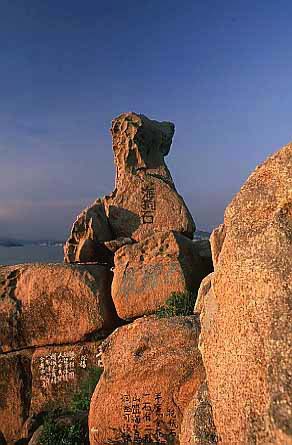
Imagination seems important along this path. Soon, you’ll pass a natural structure locals have dubbed Vase Rock, as it supposedly resembles a flower vase. Hmm.
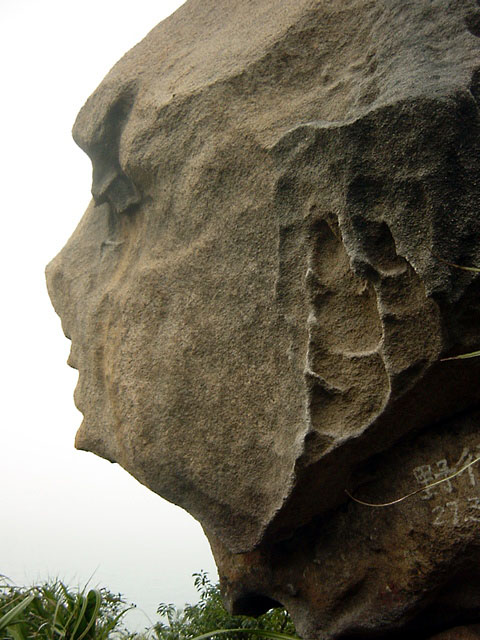
Human Head Rock is a far better candidate for a lookalike contest, in my view. Especially if you walk down and partly round the rock, for the prime view of the nose, ear and other features on this giant boulder perched on a slim “neck”.
On from here, the Mini Great Wall runs to a finish on a south-facing headland. But you can continue exploring Cheung Chau by taking a flight of steps up from near the Human Head Rock.
There are winding trails along headlands, over hills and through small valleys in this southeast corner of Cheung Chau – but you shouldn’t get lost, especially as the Tourism Board has lately put up signposts. You can curve right and down towards the ferry pier, or continue to Cheung Chau’s also attractive southwest corner.
Past the Pirate’s Cave
Lest you want to head to southwest Cheung Chau directly from the ferry pier: turn right, and follow the road alongside the typhoon shelter. You’ll leave the main village, pass a bicycle parking area that’s for some reason been built a long way from anywhere, and arrive at a tiny harbourside village, Sai Wan. Here, you can walk a short trail to a Tin Hau temple. Then, head up and over the headland, to the path that drops down towards Cheung Po-tsai Cave.
Cheung Po-tsai was a pirate, who commanded a large fleet that pillaged shipping in the Pearl River mouth. But althought he’s supposed to have cached his booty in the cave – which isn’t much more than a cleft in the rock – there’s no evidence he did so. Nope, no pirate treasure, though you can perhaps rent a torch to clamber from one cave opening to the other.
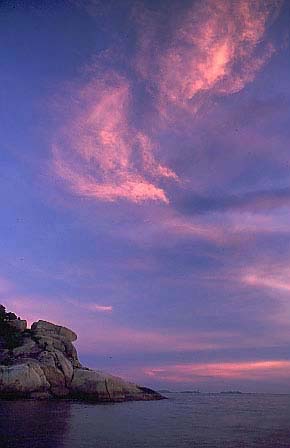
More rewarding, I think, is the path that turns off to the left, down steep steps between boulders, to the rocky coast. There’s a concrete path over the rocks, too, but this quickly halts at a small cove (private land issues, stopping government building the concrete trail here – and a good thing too if you ask me). Here, you can fairly easily continue round the cove at low tide; when the tide is in, you can wade, or use rough ladders to climb up and over boulders.
Then, there’s concrete trail again – steps leading steeply uphill. This is a fairly wild corner of Cheung Chau, with views to Lantau and other islands. There are big boulders including the Reclining Rock – sadly defaced with graffiti, and the trail soon drops again, to the Italian Beach (as westerners living on Cheung Chau have known it).
Peak Road, Pavilions, and Dinner At Last!
From the beach, there’s a path up, to a junction with Cheung Chau’s Peak Road – which is really just a footpath. Turn right, and you can walk along southern Cheung Chau, perhaps later turning right to the southeast corner, or continuing till the road drops to the waterfront near the ferry pier.
Part way down the slope towards the harbour, on the right, is one of the old Boundary Stones, which once marked off the south of the island as a special residential area – mainly Europeans I believe, with a fair proportion missionaries, who rested here between expanding their flocks. Maybe several of the old buildings that dot southern Cheung Chau were former retreats for missionaries; though often dilapidated, with overgrown gardens, they seem the kinds of places where one may have taken tiffin on the verandah.
North Cheung Chau also has trails. From beside the Pak Tei Temple, steps lead uphill, to a path towards a hilltop pavilion overlooking most of Cheung Chau. New trails from the pavilion run to another, newer pavilion, and down to a secluded beach.
After exploring Cheung Chau, you might head for one of the many seafood restaurants along the waterfront [maybe be leery of one that looks aimed at tourists; if you can, look for places with locals – islanders]. With fishing families among the main customers, and views of fishing boats in the harbour, Lantau beyond, these are far more “real” than most Hong Kong seafood restaurants. Cheaper, too, though the food can be great.
Don’t worry too much about return ferry times – they’re pretty regular till after 11, and if you tarry beyond that there’s one after 2 (there are a few pub-type bars and karaoke bars to help keep you occupied). Or even stay the night, in a holiday flat, or the Warwick Hotel.
Cheung Chau HK – website on Cheung Chau, including forum and Cheung Chau photo gallery.


Ferries to Cheung Chau
not run by Star Ferry, but by First Ferry:
Ferries between Central and Cheung Chau
Life on Cheung Chau
I needed some info on the Bun Festival so thought I would check to see if there was anything on the internet. Was so excited to see your story and guide to present day Cheung Chau. Thank you! When I was a girl I lived on Cheung Chau from 1950 to 1954 and it is hard to imagine it is the same island you describe.
Being an American I lived in a house on the southern hill just past the Bible School. For most of the time I lived there only one other family lived fulltime on the hills so five of us kids had the full run of the island above the village. The Kwun Yan beach (called Afternoon Beach by the English) was restricted to Europeans and strictly enforced. Tung Wan Beach (called the Chinese Beach) was the only one the village people could use and swimming and sunbathing were not a popular past time for the native people so didn’t get a lot of use. There was also a tiny Morning Beach down in the cove from what now appears to be the Jockey Club.
For the Europeans the most direct way to the Italian Beach was from the Peak and not many of the houses on the peak road were ever occupied and so it was mostly deserted. When I lived there a few British families came to the island for a couple of weeks in the summer time to get out of the heat of Hong Kong. AC was not the norm back then. But the beaches were pristine.
There was no running water and no electricity up on the hills at that time. The hospital and police station must have had generators as they were the only buildings I remember as having electricity. We didn’t dare eat any of the food sold or served in the village as the produce they used came from the farms in the little valleys and were fertilized by night soil. All our groceries were sent from HK.
The trees had all been cut down by the Japanese during the occupation of WWII so the island was quite barren back then. They also knocked down many of the houses on the hills to get the rebar out and when I lived there the remaing walls and rubble made great "play grounds".
Thanks again for giving me the chance to ‘visit’ Cheung Chau – you were so descriptive it was a delight to read.
Morning Beach
Many thanks for the info; fascinating!
I believe Morning Beach is Nam Tan Wan; lies south of the Sports Ground. Very small; pleasant tho, with temple just beside it.
Thank you for this!
I’m visiting Hong Kong and I’ve grown a bit tired of all the shopping, but this sounds amazing!
Shek Kwu Chau (near Cheung Chau) build waste management facility
Shek Kwu Chau, the government tend to build waste management facilities February 17, 2011
(Excerpt) Secretary for the Environment Edward Yau today (February 17) that, according to the results of environmental impact assessment report, and to measure adjacent to the Tuen Mun Tsang Tsui and Shek Kwu Chau, an artificial island that features two possible sites, the Government is inclined to The artificial island of Shek Kwu Chau, led a site integrated waste management facilities.
(Excerpt) of the EIA report has been posted here, the public can be on or before March 18 to express their views on the report of the Advisory Council will provide advice.
http://www.news.gov.hk/en/categories/environment/html/2011/02/20110217_111506.shtml
“The Government intends to Shek Kwu Chau is located in the outlying islands to submit their views to the Government built incinerators”
Shek Kwu Chau Island area about the environmental impact assessment report incinerator.
http://www.epd.gov.hk/eia/register/report/eiareport/eia_1932011/index.htm
Public Comment Form
http://www.epd.gov.hk/eia/english/forms/index3.html
https://203.169.143.33/eiacomment/ch_Project_Comments.aspx
Environmental Advisory Committee
http://www.epd.gov.hk/epd/tc_chi/boards/advisory_council/maincontent.html
Facebook
http://www.facebook.com/event.php?eid=201274986550631&index=1
Cheung Chau
This is sssssoooooooo awesome!